Sound familiar?Toronto
- The call
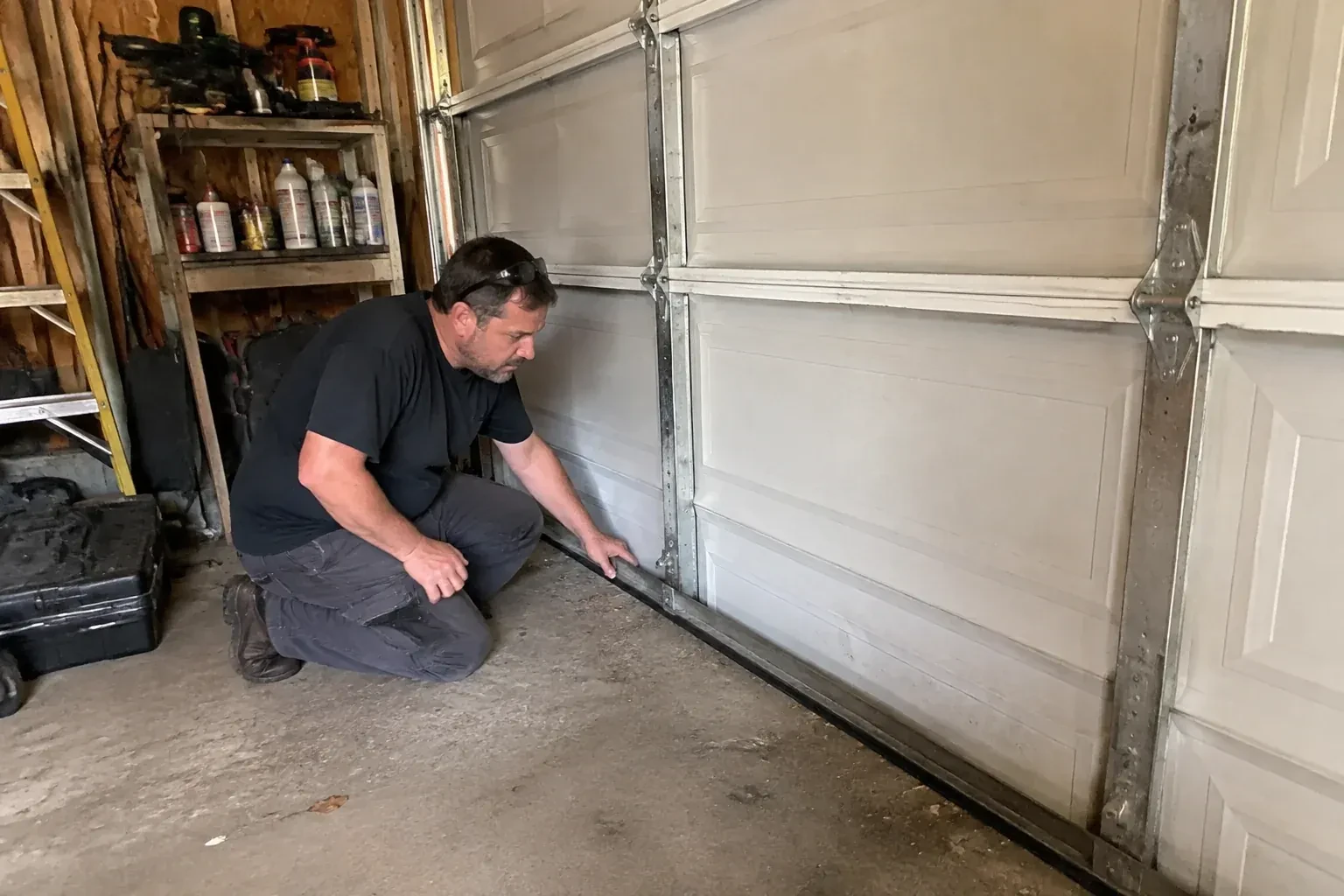
- Looking up at the coil above the door, you can see a clean split with a gap of several centimetres between the two halves. The rest of the spring looks fine, but the door has become almost impossible to move by hand.
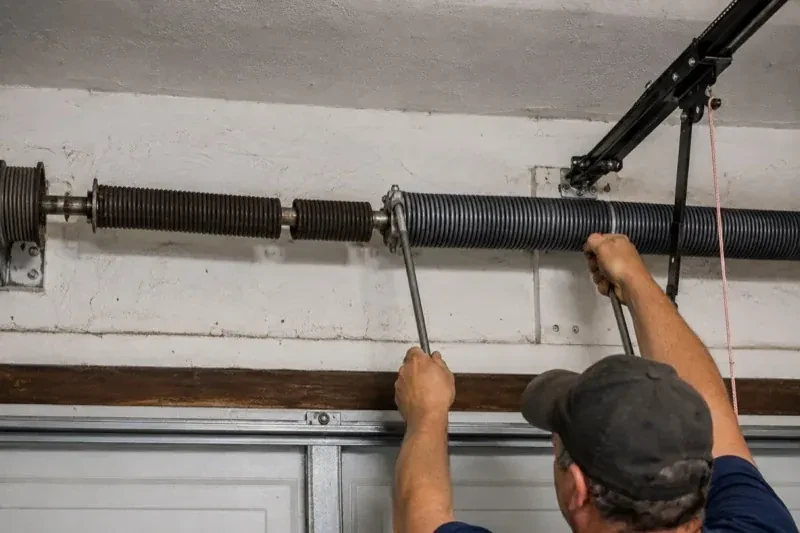
Every spring is built for a number of open-close cycles, and replacement is a natural moment to choose that number deliberately. A standard residential spring is commonly rated around ten thousand cycles; a family that opens the door six times a day uses those up in a few years. Higher-cycle springs use heavier wire and a longer coil to produce the same force with less stress on the steel, so they last proportionally longer. The technician can explain the trade-off and fit whichever option suits the household's use of the door, then wind and balance it accordingly.
Sound familiar?Toronto
Torsion Spring Replacement · Toronto
Scene 1
Doors are set up in several ways, and the replacement has to match. The technician notes whether there is one spring or two, whether the shaft is a single piece or two halves joined by a coupler, and what the shaft diameter is. Drum type is read from the drums themselves: standard-lift drums for a normal ceiling, high-lift or vertical-lift drums where the door rises well above the opening, or a rear-mounted assembly in a low-headroom garage. Track radius and headroom are measured because they change how many turns the spring needs and which drums it must work with.
Scene 2
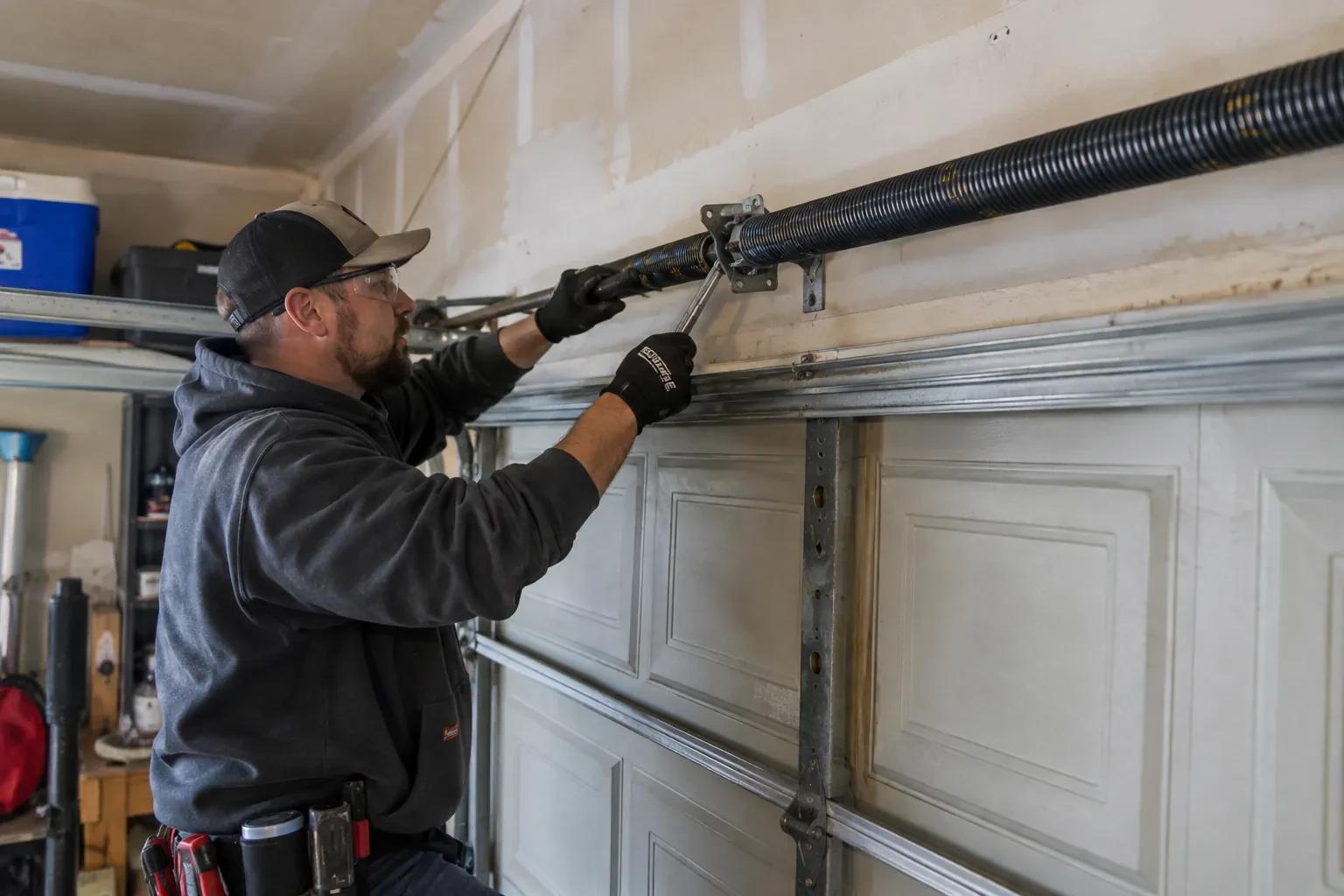
With the door clamped and the opener disconnected, the technician releases any tension left in an intact spring, loosens the drum set screws and slides the drums inward, then removes the old spring from the shaft. Bearings are inspected while the shaft is free. The new spring goes on with its stationary cone bolted to the centre bracket and the winding cone facing the drum. Drums are refitted, cables seated, the shaft levelled and cable tension evened on both sides. Winding follows, then the set screws are seated and the clamps come off for a balance check. Each stage is done deliberately and in order.
Scene 3
A little care keeps the new spring running smoothly for its full life. Once or twice a year, spray the coils with a garage-door lubricant so the steel moves without rubbing, and do the same for the hinges, roller bearings and the end bearings at each side of the shaft. Autumn is a good time, since cold thickens grease and stiffens hardware. Leave the track dry, because lubricant there collects grit. Over the years, glance at the spring for gaps or rust streaks, and if the door starts to feel heavier by hand, book a balance check before a spring reaches its limit.
What shapes the quoteBedford Park Garage Door Experts
FeesSame any hour
A spring that is intact but has relaxed slightly can be given a little more tension, within limits, to restore balance; this is a normal adjustment on a door that has settled. A spring with a broken coil is replaced as a unit, since the wire has reached the end of its life. The technician checks the condition of the steel and recommends whichever restores a balanced, safe door.
On a two-spring door both springs have completed the same number of cycles, so the intact one is usually close to the end of its life as well. Replacing the pair gives the door two matched springs sharing the load evenly and a fresh cycle count on both sides. The technician looks at the remaining spring's condition and the door's configuration, then explains the reasoning so you can choose the scope with a clear picture.
Balance means the spring is holding almost exactly the door's weight, so the door neither flies up nor slams down and the opener only guides it. It is tested by releasing the opener, lifting the door to about waist height and letting go: a balanced door stays there. The technician fine-tunes in quarter turns of the spring until the door holds at several heights and travels evenly on both sides.
TorontoOntario
Torsion Spring Replacement · Bedford Park, Davisville, Lawrence Park, North Toronto
Every square is one home in a hundred.
On-site assessment
The door starts to rise, gets about the height of your knee, then shudders and reverses.
(365) 605-5927, open 24/7.
On-site assessment preferred · (365) 605-5927, open 24/7